


Schedule
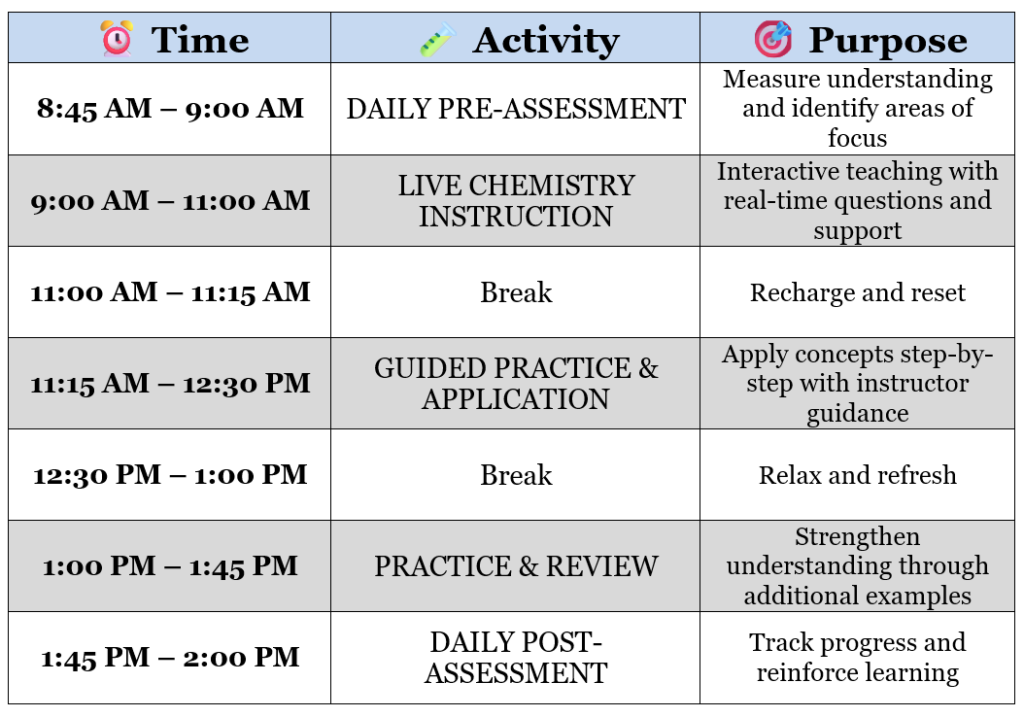
— Daily Schedule —
Reminder: All times shown are in PST (Pacific Standard Time)
— Syllabus Overview —
Week 1 – Mathematics In Chemistry
Week 2 – Matter & Energy
Week 3 – Isotopes Of Atoms & Ions
Week 4 – Nomenclature Of Inorganic Compounds
Week 5 – The Mole, Constituents, & Molecular Formulas
Week 6 – Chemical Reactions
Week 7 – Limiting Reactants, Percent Yield, & Excess Reactants
Week 8 – Light, Electron Configuration Of Atoms & Ions
Week 9 – Lewis Structures, VSEPR, & Molecular Shapes
Week 10 – Solutions
Week 11 – Solution Stoichiometry
Week 12 – Gas Laws & Gas Stoichiometry
Week 13 – No Bootcamp: Thanksgiving
Week 14 – Review
Week 1
Math in Chemistry: Together, we’ll master the essential mathematical skills used throughout chemistry while learning how to apply significant figures correctly in calculations. Over the week, we plan to cover addition, subtraction, multiplication, division, and mixed operations, emphasizing the rules for determining the correct number of significant figures in every answer.
Week 2
Please note – Every week after Week 1 requires purchase of Bootcamp to access.
Matter and Energy: Explore the building blocks of chemistry by learning about matter, its properties, and the different ways it can change. This lesson also introduces energy and how it is transferred, absorbed, and released during physical and chemical processes. In addition, we’ll be reviewing material related to Dimensional Analysis, PEMDAS, and Density.
Week 3
Isotopes of Atoms & Ions: This week we’ll introduce isotopes, explaining how atoms of the same element can have different numbers of neutrons. Students will learn how to identify isotopes, calculate the number of protons, neutrons, and electrons in an atom, and understand how isotopes are represented using atomic notation. We’ll also cover heat conversion, temperature, and the difference between them.
Week 4
Nomenclature: Together, we’ll learn the fundamentals of chemical nomenclature, including how to name and write formulas for ionic compounds, covalent compounds, acids, and hydrates. Students will develop the skills needed to identify chemical compounds, apply naming rules, and confidently interpret chemical formulas. Before class ends, we ensure that students will build a strong foundation in chemical naming conventions essential for success in chemistry.